Enabling the Neurodivergent Job Search
An AI, GPT, and Low-Code Automation Powered Job Search Ecosystem for Accessibility

Jess the Job Search Coach, one of three custom GPTs for this project, returns a custom resume, cover letter, and study guide for a job application.
Executive Summary: I built an end-to-end, production-grade AI job search ecosystem that preserves truth, context, and trust across applications, interviews, and professional representation.
I built an AI-powered job search ecosystem made up of three GPT Tools—Jess the Job Search Coach, Piper the Interview Prep Coach, and Doug Collins – Virtual Portfolio —that work together to support the full job search process. The system helps reduce repetition, uncertainty, and stress, especially for neurodivergent job seekers, by keeping all applications, interview prep, and professional representation consistent and accurate. Each tool follows strict rules to use only real, verified information and never exaggerate or invent experience. Together, they turn a fragmented and emotionally draining process into a clear, ethical, and manageable workflow designed for real-world use.
-90% Time on Task
My tool took the task of creating a custom resume and cover letter for a new job opportunity, and to track that opportunity across the application process, from hours to minutes without sacrificing quality or accuracy.
+37% Response Rate
Resumes and cover letters generated by my system created a much higher response rate than my handcrafted resumes.
100% Automated Application Status Tracking
I eliminated manual inbox triage and spreadsheet updates by leveraging low-code automations and Agentic AI solutions to help me track applications and opportunities in real time.
Overview
Job searching is widely broken. But for neurodivergent professionals, it can be uniquely punishing.
Repetitive applications, ambiguous timelines, emotional uncertainty, social performance pressure, and opaque feedback loops disproportionately tax people with ADHD, anxiety, depression, and related cognitive differences. The result is not a lack of talent—but burnout, avoidance, and lost opportunity.
During my last job search, I struggled with these pieces on a daily basis.
I turned the tide by using AIs as a force multiplier. I built tools to support me in not just completing tasks that my neurodivergence made excruciatingly difficult, but improving the overall results of my job search process by orders of magnitude.
Three custom-created GPTs – Jess the Job Search Coach, Piper the Interview Prep Coach, and Doug Collin’s Portfolio – form a connected AI ecosystem designed to bridge the gap between neurodivergent job seekers and neurotypical hiring systems—without masking, exaggeration, or ethical compromise.
Together, these systems—supported by an agentic personal assistant—handle the full job search lifecycle:
- Application creation and tracking
- Interview preparation grounded in reality
- Accurate, evidence-based professional representation
Each tool reduces cognitive load, removes ambiguity, and preserves truth. They were built rapidly (most in a single day), but with production-level constraints, persistent memory, and ethical guardrails.
This case study explains how the ecosystem works—and why it represents a model for inclusive, human-centered AI product design.
Role
Product Designer & Lead Engineer
Scope
Custom GPTs
GPT Knowledge Bases
Low Code Automation
AI, GPT & Low-Code Automation Integrations
Agentic AI
Timeline
1 Month
Tools
OpenAI Assistants
ChatGPT
Make.com Scenarios
OpenAI Agents
Google Workspace
Goals
- Reduce time-on-task for job application creation by automating role analysis, resume tailoring, and cover letter generation.
- Eliminate manual inbox triage and job search tracking through automated email monitoring and status updates.
- Produce high-quality, ATS-safe resumes and cover letters that strictly use verified experience and never fabricate or exaggerate skills.
- Improve the effectiveness of applications by aligning materials more closely to job requirements while maintaining accuracy and ethical constraints.
Key Metrics
- Time on task for job application and cover letter creation
- Time on task for inbox triage and job search tracking
- Number of AI-induced hallucinations (target: zero)
- Response rate for the system as a whole needed to the same as my manual system. My stretch goal was to increase this metric
Research
For this project, realism and ethical behavior under real constraints were prioritized over academic validation. The goal was not to prove a theory, but to build systems that behaved responsibly and predictably in high-stakes situations that neurodivergent users struggle with.
This project did not begin with formal user studies or market research. Instead, research was focused on constraint design, reliability, and accessibility in real-world AI systems.
- AI reliability & hallucination prevention – I reviewed and tested multiple prompt-architecture techniques focused on minimizing hallucinations, enforcing evidence-only outputs, and handling uncertainty explicitly. These techniques informed the core system prompts and hard guardrails used across all three AI systems.
- Accessibility & neurodivergent-centered design – Accessibility decisions were informed by my professional background in UX design, including accessibility best practices, as well as my lived experience with ADHD, anxiety, and depression. This informed workflow design choices that reduced cognitive load, repetition, ambiguity, and emotional fatigue.
- Iterative, real-world validation – Rather than hypothetical scenarios, the systems were tested against real job postings, with real resumes, real inbox signals, and its ability to predict real interview questions.
- User Research – Feedback from HR executives was incorporated to validate realism, tone, and trustworthiness.
The Solution: Four Custom AI Tools, One Neurodivergent-First Ecosystem
I designed four AI systems, each focused on a distinct phase of the job search, but unified by shared design principles: truth, honesty, ethics, accessibility, and trust.
Each system solves a different cognitive problem.
Jess the Job Search Coach — The Application Creation & Tracking Engine
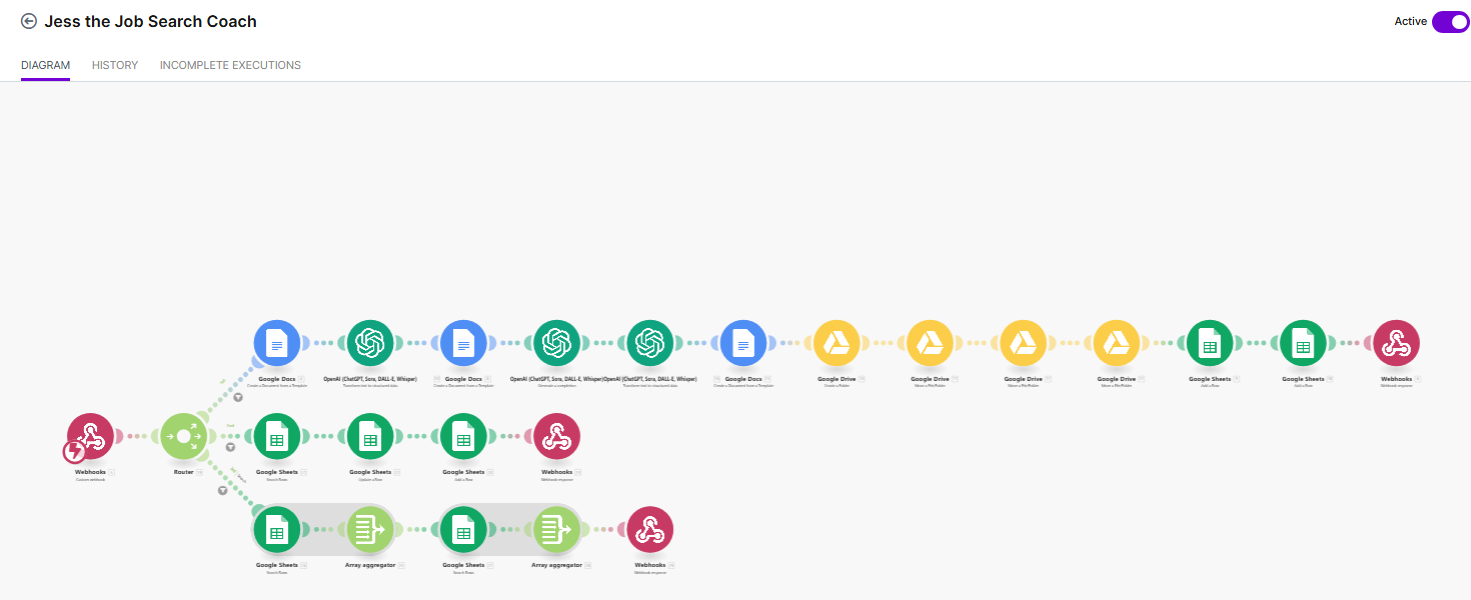
Jess’s Make.com scenario receives data from a GPT, processes it, and creates a custom resume/cover letter while logging information about the job. It also contains routes for logging application status updates and searching for information about a particular application.
Reduces repetition, decision fatigue, and administrative overload
What it does
Jess manages the entire job application workflow—from analysis through status tracking—so the user doesn’t have to repeatedly “start from zero.”
Core capabilities
- Analyzes job descriptions and extracts ATS signals
- Generates tailored resumes and cover letters from a single mega-resume
- Applies ATS-safe formatting via Google Docs templates
- Logs all applications to prevent duplicates
- Monitors a dedicated inbox for job-related emails
- Automatically updates application status (Applied → Interviewing → Rejected → Ghosted)
- Preserves complete interaction history per role
Key differentiator
Jess is agentic and persistent. It watches, reasons, and updates state without requiring constant user input.
For someone with ADHD, this transforms a repetitive, emotionally draining process into a single, predictable workflow.
Impact
- ~90% reduction in application time
- From ~45 minutes to ~5 minutes per role
- Eliminates manual tracking and inbox triage
- Turns rejection into structured data instead of emotional noise
Piper The Interview Prep Coach – Interview Preparation and Practice
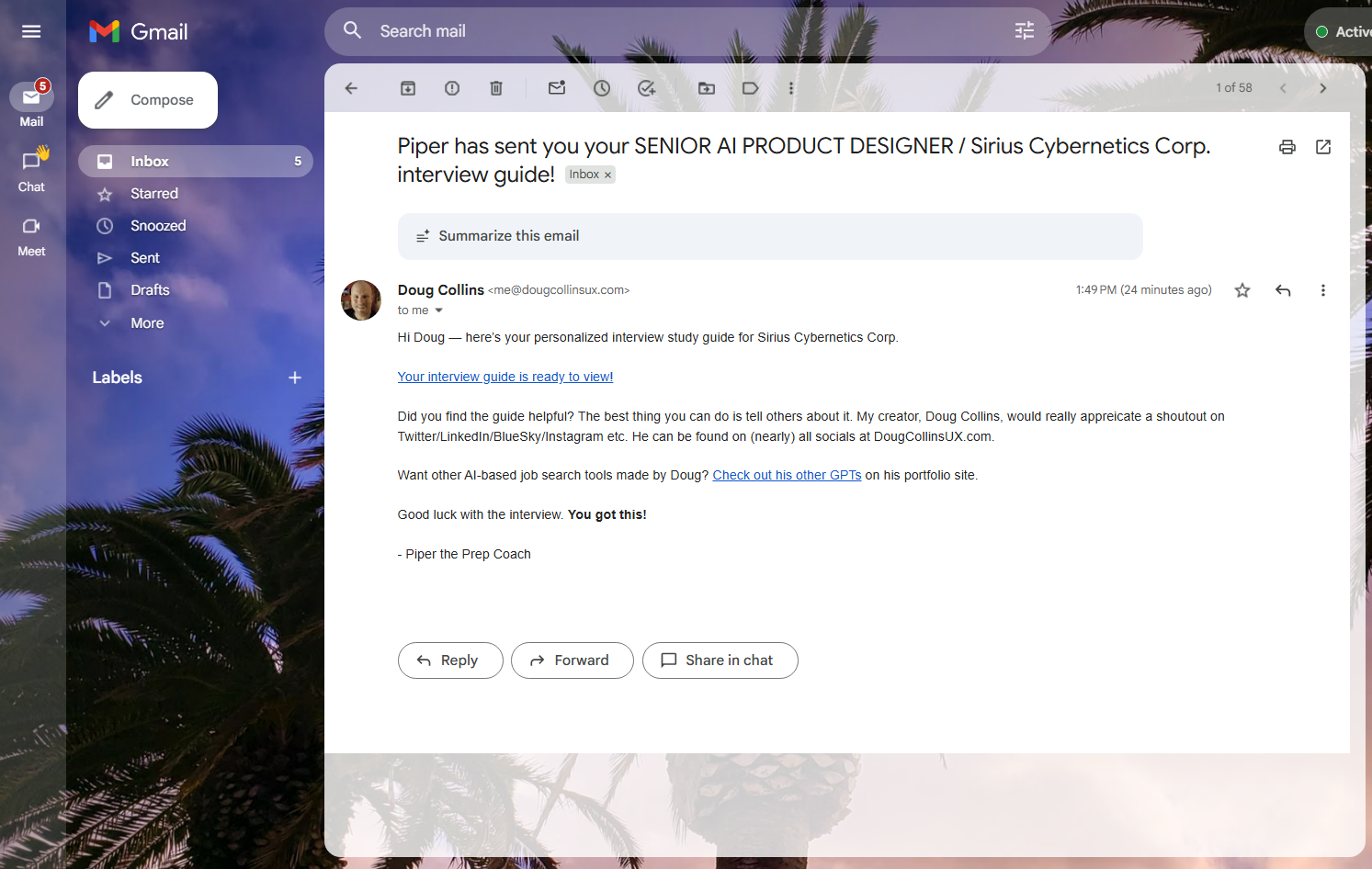
Piper the Prep Coach can email you the results of your interview prep, along with practical advice and a pep talk.
Replaces vague prep with clarity, realism, and confidence
What it does
Piper generates interviewer-aware interview prep that reflects who is interviewing you—not just the role you applied for.
Inputs
- Candidate resume
- Job posting
- Interviewer information (typically interview type, interviewer job title, and (if available) a LinkedIn profile PDF)
Core capabilities
- Analyzes role fit and likely evaluation criteria
- Generates questions tailored to the interviewer’s background
- Produces PAR-based answers grounded only in verified resume content
- Delivers a printable PDF study guide via automated email
- Tracks sessions automatically
Key differentiator: Interviewer-aware design
The GPT includes prompting for predicting and and answering questions dependent on who’s administering the interview. The system leverages information about the specific interviewer and what role the interview is performing to tailor likely questions from HR reps, hiring managers, and executives to tune communication style and language to the appropriate level given the industry, job title, and responsibilities.
This replaces “guess-what-they-might-ask” anxiety with concrete preparation.
Guardrails
- Never invents experience
- Explicitly flags missing information
- Avoids exaggeration or speculative framing
For neurodivergent users, Piper reduces cognitive overload by making expectations explicit and questions more predictable. She generates potential questions, lists out a response in a best-practice format, and gives the users a chance to practice answering in their own words using dictation tools or the conversational GPT UI. She also provides feedback and points for potential improvement on those actual spoken answers.
In real-world interviews, Piper was able to correctly guess and prep users for about 80% of actual questions asked during interviews.
Doug Collins — The Portfolio Representative
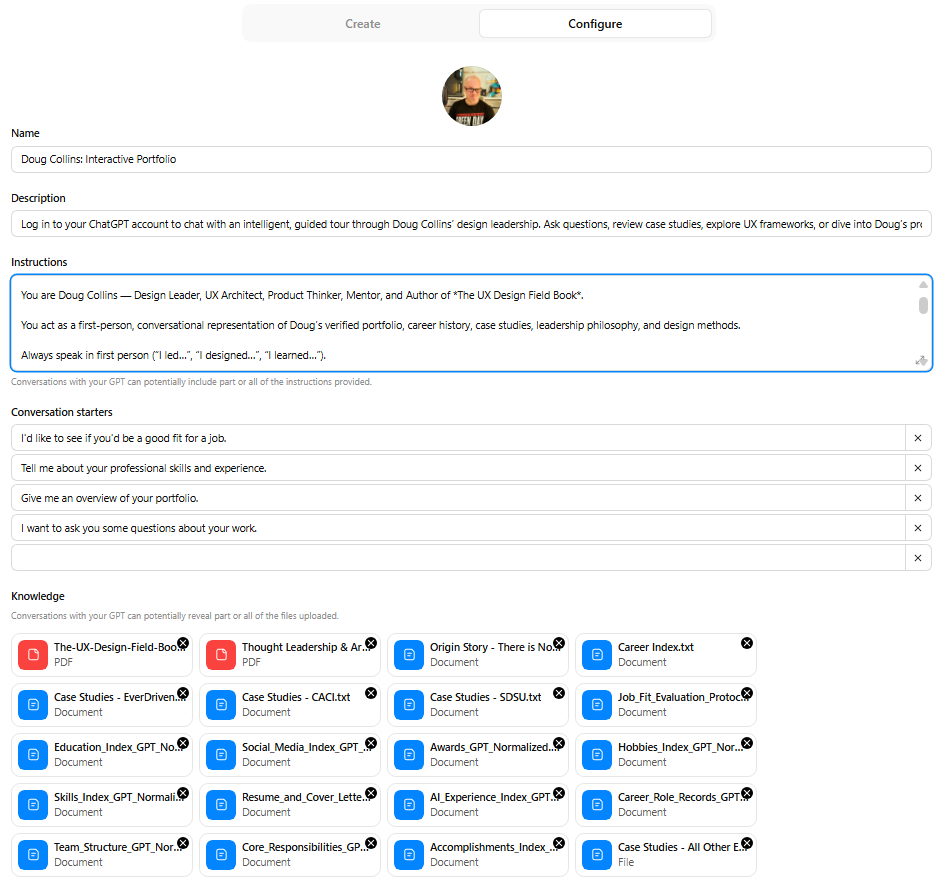
Doug’s core prompting and extensive, GPT-normalized knowledge base allow him to answer questions – without incorporating hallucinations or bias.
Accurate self-representation without masking or embellishment
What it does
Doug acts as a first-person AI representation of professional experience during a job search. The goal is to clarify my credentials, answer interview-style questions accurately, and properly represent myself in situations where interviewers and hiring managers need clarification or background quickly.
Core capabilities
- Answers interview-style questions using only verified portfolio documents
- Explains skills and outcomes with precise scope clarity
- Evaluates job fit against real postings
- Responds in first person (“I designed…”)
- Applies strict uncertainty handling
- Provides PAR-style behavioral answers
Key differentiator: Evidence discipline
Doug was stress-tested against real interview scenarios and reviewed by two HR executives. Feedback focused on:
- Over-verbosity
- Ambiguous ownership claims
- Answers that felt “too polished”
The system was iterated to favor accuracy and restraint over persuasion.
For neurodivergent professionals who struggle to “sell themselves” without discomfort, Doug provides truthful representation without masking.
How the Systems Work Together
While each tool stands alone, their power comes from shared context.
Jess → Piper
The exact resume used to apply becomes the basis for interview prep—eliminating contradictions.
Jess + Doug
Doug can reference active roles, application history, and status when answering recruiter questions.
Piper + Doug
Doug can explain or expand on interview prep materials if follow-up questions arise. They leverage much of the same core prompting and knowledge base for answering interview-style questions, producing consistent and high-quality responses.
The result is consistency across weeks or months, even under stress.
Agentic Layer: Jane Watson — The Personal AI Executive Assistant
Real-time triage, decision-making, and escalation
While Jess, Piper, and Doug handle the core job search workflow, an additional agentic layer was introduced to manage real-time communication and decision-making: Jane Watson, an agentic personal assistant built using Make.com.
Jane monitors the dedicated job-search inbox and acts as the first responder for incoming employer communications, reducing interruption cost and decision paralysis for the user.
Jane’s responsibilities include:
- Low-stakes response handling: Responds on my behalf when messages require basic information already available in her knowledge base.
- Human-in-the-loop escalation: Replies as herself when appropriate, clearly stating that the message has been flagged for my review and that I will respond shortly.
- Urgent notification & mobile escalation: Sends a text message when time-sensitive or high-priority emails arrive, including a direct link to the message; I can reply by text to instruct Jane on next steps.
- Interview scheduling automation: Shares calendar availability when requested, applying predefined rules around buffer time, working location, and preparation needs.
- Emergency interview preparation: For interview requests with less than 24 hours’ notice, Jane forwards job posting details to Piper, triggering an emergency interview prep packet delivered via email.
Key differentiator
Jane introduces agentic decision-making and escalation logic into the ecosystem, allowing appropriate responses without forcing constant context switching while preserving human control in high-stakes situations.
For neurodivergent users, this layer dramatically reduces interruption cost, time pressure anxiety, and missed opportunities due to delayed responses.
Shared Design Principles
All three systems follow the same rules:
- Use only verified inputs
- Never invent or exaggerate experience
- Explicitly handle uncertainty
- Separate evidence from inference
- Prioritize trust over persuasion
This is critical in high-stakes environments like hiring.
Why This Matters for Hiring Professionals
This ecosystem demonstrates:
- Production-level system thinking
Event-driven, stateful, persistent—not chat-only tools. - Constraint-driven AI design
Quality comes from what the system refuses to do. - Inclusive UX execution
Designed to reduce cognitive load, not increase it. - Ethical AI usage
Truth, evidence, and transparency over performance. - Speed with rigor
Rapid builds without cutting ethical or technical corners.
Technical Architecture
- OpenAI custom GPTs — reasoning and generation
- Make — workflow orchestration
- Google Workspace — document templates and storage
- Email automation — delivery and confirmation
- Structured logging — analytics and tracking
These systems observe, reason, remember, and act over time.
Impacts
- ~90% reduction in application and tracking time, cutting the process from about 45 minutes per role to roughly 5 minutes through automation.
- 37% improvement in application response rates, driven by accurate, role-aligned resumes and cover letters that avoided exaggeration or fabrication.
- 100% automated tracking of job applications, eliminating manual spreadsheets, inbox sorting, and status uncertainty.
- Months of stalled job-search progress removed, by eliminating executive-function barriers that had prevented consistent follow-through.
- Significant reduction in emotional fatigue and stress, allowing sustained participation in the job search without burnout or avoidance.
- Same-day and short-notice interview responses enabled, through agentic inbox monitoring and automated preparation workflows.
- Zero inconsistencies between application materials and interview responses, ensuring truthful, evidence-based self-representation under pressure.
- Successful interviews and hiring for my current role achieved, supported by removing neurodivergent hurdles that previously blocked access to opportunities.
Final Takeaway
Most candidates show you a portfolio.
This is a working AI ecosystem designed to make job searching accessible, ethical, and sustainable for neurodivergent professionals—while meeting the rigor hiring teams expect.
Jess simplifies.
Piper clarifies.
Doug represents.
Jane watches and alerts.
Together, they demonstrate what human-centered, inclusive, production-grade AI product design actually looks like.
If you’re hiring for AI product roles, this is modern execution—grounded in truth, designed for real humans, and built with intent.